 Cat Trap
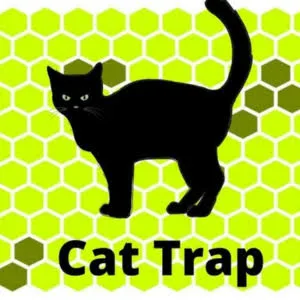
A cat sits in the middle of a field of green hexagons. You can’t touch it. All you can do is drop one barrier per turn and hope the cat runs out of road before it reaches the edge. Cat Trap runs in your browser with no download, and the rules fit in a sentence. Winning is harder than it looks.
The board is a honeycomb of hexagons, not squares. That matters because each hexagon touches six neighbors, so the cat has more ways around a barrier than it would on a square grid. A wall that looks solid can have a gap you didn’t see. seeles
| Who | What happens |
|---|---|
| You | Click one open tile, which becomes a barrier |
| The cat | Moves one step to an adjacent open tile |
| Repeat | Until the cat is trapped or reaches the edge |
You never move the cat. You only change the terrain it has to cross.
If the cat reaches the edge of the grid, you lose. You win by leaving it with no open neighbor to step to. Some versions also have difficulty settings or timers, so check your build’s rules before you start. google
These are general puzzle-logic habits, not an official solution.
You’ll see this game as Cat Trap, Trap the Cat, and Circle the Cat. Related titles include Block The Pig, Trap The Mouse, and Trap The Tiger. Versions can differ in: github
If a trick works in one build and fails in another, that’s likely why.
“Unblocked” usually means a game that runs in a normal browser without installing anything. It does not mean your school or workplace allows it, so check your network’s acceptable-use rules. Skip any site that asks you to download software or install an extension just to play a simple puzzle.
Browser versions of this puzzle are built to work on desktop and mobile with simple click or tap controls. On a phone, tap carefully. On a small screen, neighboring hexagons are easy to mis-tap. seeles
Browser versions are free to play, with no download needed.
Block tiles until the cat has nowhere left to move.
The cat reaches the edge of the board.
Yes. It takes one step after each barrier you place.
There’s no guaranteed trick, but avoiding forks and blocking along the cat’s route helps.