 B Cubed
If you've spent any time browsing puzzle games during a study break or a slow afternoon at work, you've probably run into B Cubed. It's one of those deceptively simple browser games that looks easy at first glance and then quietly eats an hour of your day. And if you're on a school or office network where gaming sites tend to get blocked, you've probably also gone looking for a "B Cubed unblocked" version so you can actually play it.
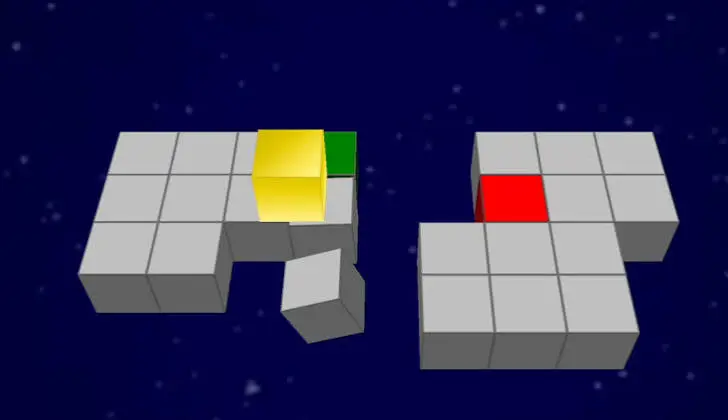
B Cubed is a browser-based puzzle game built around a simple idea: you control a rolling cube that has to make its way across a grid to reach an exit tile. Sounds easy enough, except the grid is covered in numbered or colored squares, and each time your cube lands on one, that square disappears. Land on the same color twice in a row, or run out of safe tiles before you reach the goal, and you're starting the level over.
The challenge comes from the fact that a cube doesn't move the way a normal game character does. Rolling it forward, backward, or sideways changes which face is touching the ground, and that face's value determines what happens next. So you're not just thinking about where to go — you're thinking several rolls ahead, tracking which face will be down when you get there.
It's a small mechanic, but it turns basic pathfinding into genuine spatial reasoning. That's part of why it's stuck around as a favorite in the Cool Math Games era of browser puzzlers and why it still gets played today.
Most schools and workplaces run web filters that block anything categorized as a gaming site, regardless of how harmless or educational the game actually is. B Cubed often gets swept into that net simply because it lives on a gaming portal.
"Unblocked" versions are just mirrors or rehosted copies of the game on sites that haven't been flagged by those filters yet. They let you play the exact same game through a browser without needing to install anything or bypass any actual security systems — it's the same HTML5 game, just hosted somewhere your network hasn't blacklisted.
A few practical notes if you're going this route:
Once you're in and playing, here's where most people get stuck — and how to get past it.
Think in faces, not tiles. The biggest mental shift is realizing you're not just tracking your position on the grid, you're tracking which face of the cube is currently facing down, up, and to each side. Before you make a move, ask what face will land on the next tile, not just where the cube will end up.
Plan two or three moves ahead. Early levels are forgiving, but later ones require you to sequence rolls carefully so you don't waste a tile before you need it. If you roll onto a tile too early and it vanishes, you may cut off your only path forward.
Use the edges of the grid. Corners and edges limit your rolling options, which sounds bad but can actually simplify your decision tree. When you're unsure of your next move, rolling toward a boundary often narrows things down.
Don't rush. There's rarely a time pressure element in these puzzles. Taking an extra ten seconds to visualize the roll sequence saves you from restarting the level.
Restart early if you sense a mistake. If you can tell three moves in that you've boxed yourself into a dead end, it's usually faster to reset than to try to improvise your way out.
Yes, actually. Games like B Cubed are popular in classrooms specifically because they exercise spatial visualization — the same mental skill used in geometry, 3D modeling, and even some engineering disciplines. Tracking which face of a rotating object is where, without seeing it directly, is a genuinely useful cognitive skill, which is part of why the game has lived comfortably on educational game sites for years alongside straightforward math games.
So if anyone gives you a hard time for playing it during a break, you can honestly say it's a little bit of mental exercise dressed up as a distraction.
B Cubed earns its staying power the old-fashioned way: a simple concept, an easy learning curve, and just enough depth to keep you coming back for "one more level." Whether you're playing it on a school computer via an unblocked mirror or just killing time on your own laptop, it's the kind of low-stakes puzzle game that's perfect for short breaks — as long as you don't look up an hour later wondering where the time went.
B Cubed is a browser puzzle game where you roll a cube across a grid of numbered or colored tiles, trying to reach an exit tile before you run out of safe squares to land on.
Many schools and workplaces filter out anything categorized as a gaming site, even harmless puzzle games. Unblocked versions are simply rehosted copies of the same game on sites that haven't been added to those filter lists.
The game itself is safe since it's just an HTML5 browser game with no downloads required. The main risk comes from low-quality hosting sites with excessive ads or pop-ups, so it's worth sticking to reputable game portals.
No. B Cubed runs entirely in your browser. Any site asking you to download a file to "unlock" the game should be avoided.
It's a good exercise in spatial reasoning and forward planning, since you have to track which face of the cube will land where several moves in advance — a skill that overlaps with basic geometry and 3D visualization.